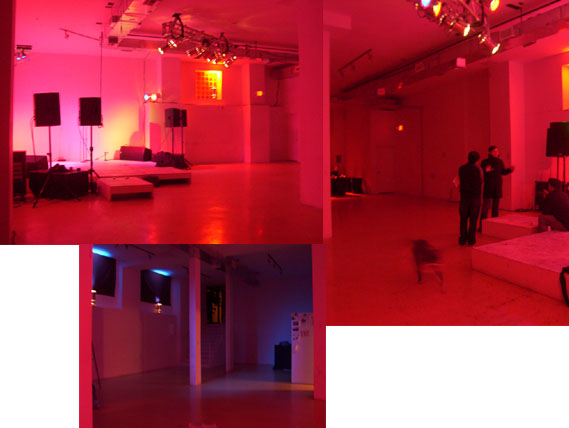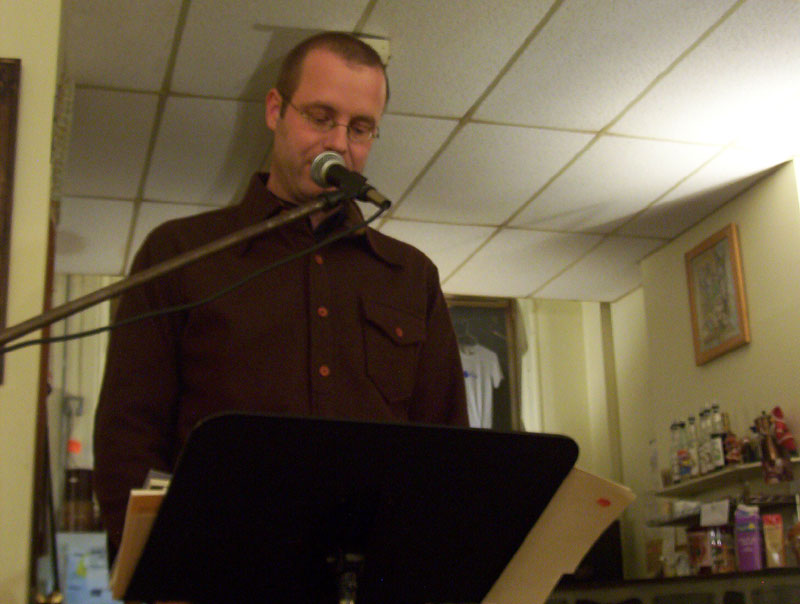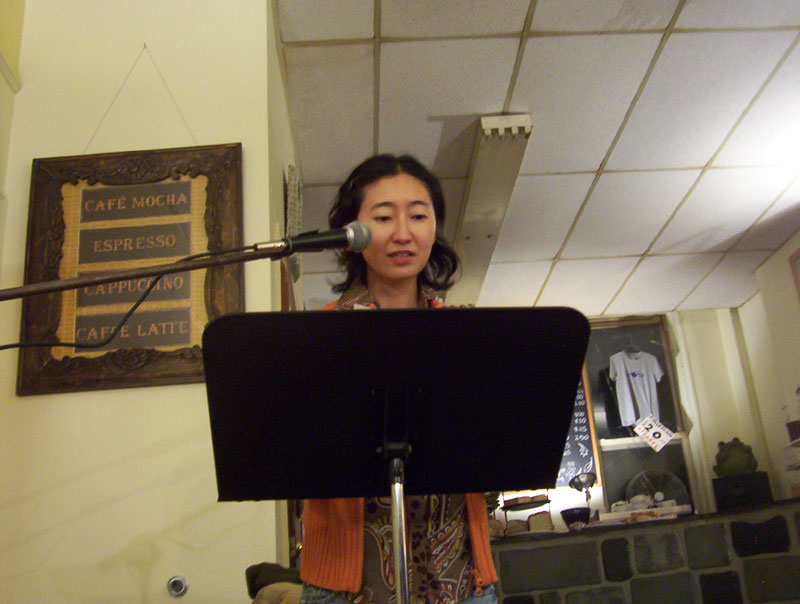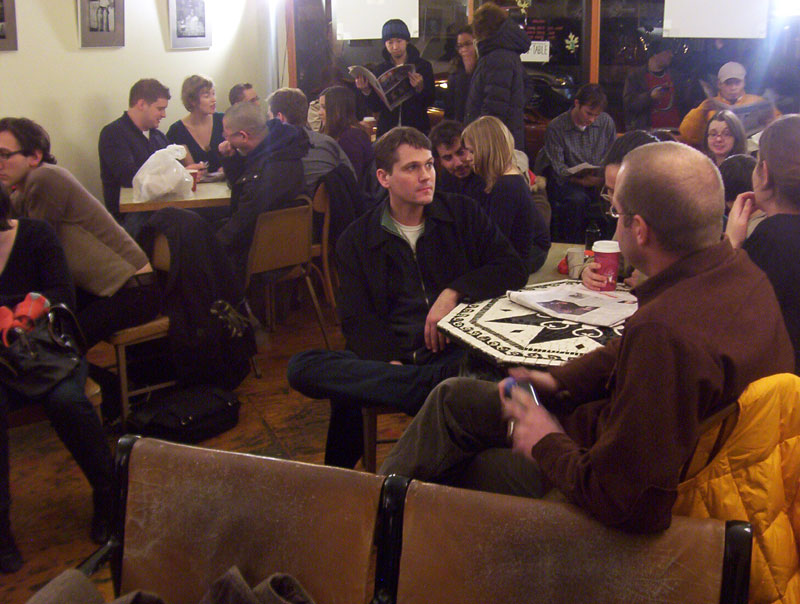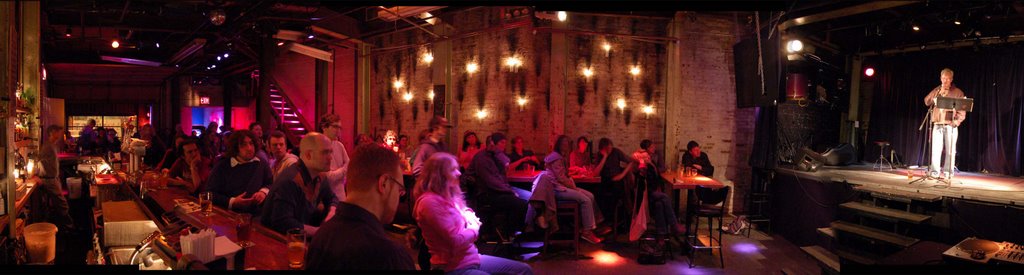
Rod Smith at the Brooklyn Poetry Bazaar, March 10th, 2007.
Panoramic image by Matt Kime.

Recent poems by Susan Briante have appeared in Hot Whiskey, OPoss and effing. A co-editor of the journal Superflux, she lives in Dallas, Texas, where she works as an assistant professor of aesthetic studies at the University of Texas at Dallas. She is the author of Pioneers in the Studay of Motion (Ahsahta Press, 2007).
Christian Hawkey is the author of The Book of Funnels (Verse Press/Wave Books, 2004), and the chapbook HourHour, which includes drawings by the artist Ryan Mrowzowski (Delirium Press, 2005). His poems have appeared in numerous magazines, including Conjunctions, Volt, American Poetry Review, Denver Quarterly, Tin House, Crowd, and Conduit, and he has received awards from the Poetry Fund and from the Academy of American Poets. He lives in Ft. Greene, Brooklyn, in a house that he believes was built by Walt Whitman, especially since it’s constantly falling apart.
Farid Matuk's poems have appeared most recently in Oposs, Lungfull!, PastSimple and Shampoo. His first collection, Is it the King?, was released by Effing Press in 2006. He lives in Dallas, Texas where he currently adjuncts at SMU and directs the Community and Mentorship Project for the literary non-profit, The Writer's Garret.
Ben Mazer’s poetry is published widely in international periodicals. His essay revealing a previously unknown source for T. S. Eliot’s The Waste Land (an 1892 essay by Elisabeth Cavazza of Portland, Maine) appears in the second number of Fulcrum: an annual of poetry and aesthetics. He is the author of White Cities (Barbara Matteau Editions) and The Big House (forthcoming).
Anna Moschovakis has been an editor and designer with Ugly Duckling Presse since 2002, helping to produce books and chapbooks by emerging writers, translations, and the poetry periodical, 6x6. Her translations of Henri Michaux, Claude Cahun, Blaise Cendrars, Théophile Gautier and others have been published by Fence, nest, and New York Review Books Classics. She is the author of two chapbooks, The Blue Book (Phylum Press, 2005) and Dependence Day Parade (Sisyphus, 2006), and her first book, I Have Not Been Able to Get Through to Everyone, is just out this fall from Turtle Point Press. She currently teaches in the Comparative Literature Department of Queens College.
Karen Weiser is the author of Heads Up Fever Pile, Eight Positive Trees (Pressed Wafer, Placefullness (Ugly Duckling Press), and Pitching Woo (CyPress, forthcoming). She lives in New York City.
Matvei Yankelevich is the editor of the Eastern European Poets Series at Ugly Duckling Presse, and co-edits 6×6, a poetry periodical. He is the co-translator, with Eugene Ostashevsky, of An Invitation For Me To Think, the selected poems of Alexander Vvedensky, forthcoming from Green Integer; and of Russian Absurdism: OBERIU, an anthology forthcoming from Northwestern University Press. His own writing has appeared in various little magazines and his critical work on Russian-American poets appears on Octopus Magazine. A chapbook of his long poem, The Present Work, was published by the Los Angeles-based Palm Press in summer 2006. He teaches Russian Literature at Hunter College in New York City.
Friday, February 16th, 7:30 PM
The Fall Café
307 Smith Street
Between Union & President
Carroll Gardens, Brooklyn
F or G to Carroll Street
FREE
Kostas Anagnopoulos was born and raised in Chicago. He is the editor and co-founder of Insurance Magazine and Insurance Editions. In 2003 he published his chapbook, Daydream. This spring Ugly Duckling Presse will publish his long poem, Irritant. He lives in Jackson Heights, Queens, and he works as a salesman.
Elisa Gabbert holds degrees from Rice University and Emerson College. She is a reader for Ploughshares and an editor of Absent. Recent work appears or will appear in journals including Pleiades, LIT, No Tell Motel, Kulture Vulture, RealPoetik, H_NGM_N, and Redivider, as well as the forthcoming anthologies The Bedside Guide to No Tell Motel – Second Floor and Outside Voices 2008 Anthology of Younger Poets. This week Kitchen Press released her chapbook, Thanks for Sending the Engine.
Poems should tempt our desires or tempt us to resist desire. If we concede that poems should help us improve ourselves, then let’s not concede that poems need to tell us how to improve. A poem that tempts us can then go on and do whatever the hell it’d like.
Zach Barocas structures his first book, Among Other Things, around a series of “Proposals,” succinct, often imagistic assertions toward a way of perceiving, and, ultimately, of living in a world of relative perspectives and revolving morals. Barocas, though almost never evasive in statement but striving for clarity of expression, manages to elude a didactic or dogmatic tone. His proposals are just that—offerings we can leave or take, as the speaker may as well. The strength of Among Other Things comes from the tension between Barocas’ attention to clarity and his distrustfulness of conclusive statements (though he attempts them again and again).
What’s radical about Barocas’ book, in a time when emerging poets have rightfully taken all liberties with language, is the essay-like precision of his sentencing, which is no less musical than any above-average avant-garde lyricist. His ethos, though does not align him with stodgy formalists: “Better to keep an eye to the banks,/transformative areas.” Though mostly the poems find centering around images presented as examples, Barocas is adept with abstract language play:
Immaculate of certainty or
immaculate from certainty,
I want to move
as the shallows move.
But Barocas is careful not to represent absolutes in statement or image:
It is possible
to live with distrust,
to fear metaphors
& images, too.
The poet’s task that Barocas asserts in his poems is not to be “any kind/of photographer,” amplifier of philosophical stances, or lyricist, but to explore arrangements of language with a cautious positivism:
Vivid-
ness is key, clarity
is key, exactitude,
like purity is key.
The irony of employing a simile to define exactitude resembles the contradictory ironies of other emerging poets who rebel against the dull, plain-spoken literal minds of the recent past. Barocas’ irony is not meant to befuddle, but to point out the hazy spots encountered whenever we attempt to articulate transcendent experiences.
In “An Uncertain and Derivative Mood,” Barocas asserts more doubts: “I’m distrustful of our flair for heartbreak.” He says, though, “I crave/the knowledge that we will lift each other so.” Though I like this poem, Barocas treads on a treacherous surface. As seen in many poems by James Wright, the poet evoked in the poem, sentimental indulgence, even when masterfully handled, can cause a reader to cringe:
Ambivalent? I want most of all to fit,
& to not betray & also not be trite.
I’ve lied. I’m begging you to spend the night.
I am spelling out this sin as means, not end.
Surely sentiment is what sends poets to find truth in rhyme. What I find endearing in even the clang (slight in this case, and rare in Barocas’ poems) is the unapologetic have-at-it.
Not surprisingly, Barocas is strongest in his essay-like poems on music. In “Two Distinctions,” Barocas explains defines “chord” and “harmony” and claims
This dis-
tinction is small, & not
always important. Here,
however, it is.
As comfortable as Barocas is with both elegy and meditation, and, weirdly, a sort of synthesis of both, subtleties of precision befit the movement of the book through the poems. In “Tenth Proposal,” he echoes himself:
Epiphanies are
sometimes delicate
& volatile &
should be treated so.
The four lines offer Barocas at his best: the boldness approaching audacity in the first line followed by the under-cuttingly cautious turn on “delicate” in the second line lead in to the rhapsodic “volatile” and conclude in direct advice that nevertheless seems to tentatively state the almost-obvious. The poem resolves in a blanketing conclusion:
one
must at all times act
graciously with one’s
realizations.
The repetition of “one” enforces a focus on one as the self reflecting on the self while allowing the phrase to resonate ambiguously between the first, second, and third person. “Fifteenth Proposal” offers a similar thought redirected to the outer world, among other things: “let each/form sustain our grace/& humility.” Sentiment holds together when it’s revelatory.
Poetry needs evidence that there is o dichotomy of styles. I am not certain how to offer an example of the perceived halves of American poetry, but certainly that halving is familiar to everyone. Barocas’ adherence to rhetoric and music at once, without relying on narrative or indulging in the literal, seems to point, as tentatively as his proposals do to improved living, to mending a gap that probably never was.
These false starts and bad jokes refuse a stable, chin-strokingly serious reading of Povel. It takes joy in the silliness in contemporary poetic conventions. However these jokes reinforce the importance of the mocked conventions. Lyn Hejinian is fake-quoted because she is, in fact, a driving influence behind the book. Povel bears significant influence from Hejinian’s My Life in its fragmented creation of personal experience. The acceptance speech points out the strange equivalence between status in award honors and the choosing of first books through poetry contests. Kim gets the chance to both express an exuberance for having her book chosen and to completely undercut the possibility that she would take it this seriously. And it's pretty funny. The epigraph both negates itself and works as a useful epigraph to the satirically self-reflexive narcissism in Povel. There is a formal constraint to the presentation of the work; each stanza has a different kind of justification, left, right, centered and repeated. This constraint, however, is so arbitrary as to be almost a joke on the conventions of formal constraint. Following the body of the book is an almost book-length set of footnotes. The book works to situate the reader between attitudes about poetry and the text before you get to the main body. It tells you that this is a book that both cares reverentially about the conventions of contemporary poetry and also finds them silly. It is as much a book of poetry as it is a work of situating the writer in relation to the forced constraints of a constructed text.
The main text of Povel spills out in a caffeine-fueled dance of statements, individual moments, non-sequiturs, information heard from others or read, family events & pop culture references. The book is so packed that it seems to emulate the Romantic mode in which the expression of experience cannot be written quickly enough (I’m thinking of stories about Shelley writing frantically with both hands). The language of Povel is in action; first person statements lack the subject, instead jumping into the action of each moment. This energy and propulsion is the prosodic driving force to the book.
From the first moment I opened it I found Povel is wildly delightful. The problem with writing a review of it is that this delight is an effect of the book as a text. Any passage is going to lack the provisional situation that makes the writing come alive which makes most of the passages lose their energy when quoted out of context. The book is delightful because of its brash comprehensiveness and inertia. The first stanza sets up some of what makes reading Povel exciting:
My roommate complains to me about how she couldn’t enjoy
Matrix Revolutions because everyone else in the theater was laughing at it. ‘Too
much psychobabble for your puny minds?!’ she asks our dorm room. I glance at her
cow-print slippers. The vomit from my Vicodin overdose was green. One of the first
things I am told as a writer is to write about what I know. (1)
Kim shifts sharply between internal and external, between immediacy and reflection, between concrete and abstract. These shifts are propulsive, and within the framework that the opening materials set up the shifts all seem to be based on a kind of desperate playfulness. These shifts consistently turn attention back to the creation of a sense of self in the book and in the writing of the book. Because of the propulsion this inward turn works to consistently recreate, and further understand Geraldine Kim as a stable entity. She reveals a life in the immediate moment-to-moment expressiveness of experience, but contains enough direct personal connection to allow for it to be read as more than an experiment. Povel is a constantly unfurling, seemingly stream-of-consciousness exploration of an individual attempting to make sense of her coming of age intellectually, culturally and sexually. But this stream is deceptive. Despite the constant search for a new turn or a new move a story builds. Characters reappear. An autobiography develops through the work. Kim doesn’t shy away from including seemingly anything in Povel.
Because of her continuous multiplicity she succeeds in moments that would seem precious in another book. “My dreams where my ex and I are siblings anyway. Feeling as lonely as a dependent/ clause without. Instead I said ‘no’ and watched his sneakers run back in the rain.” (79) But she is also able to include moments of simple presentation that ring especially true in counterpoint to the poetic play. When she talks about her brother Kim is especially direct, turning even the most ridiculous scene into a moment of dry existential wonder such as this moment of understanding budding sexuality:
‘And when I see a guy and girl kissing, it starts to rise,’ my brother says to his
twelve-year-old friends while we’re all watching TV, his voice wavering. ‘Me too!’
says his friend. Feeling extraterrestrial. (76)
Because of the exuberance of revelation Povel continually surprises me. Statements or moments arrive that feel entirely new, but continue to be absorbed by the growing body of Povel. These moments are sometimes immediate and the familiar becomes somehow profound, such as “‘Paypal scamming worm asks for bank/ details’ the computer says. That explains everything.” (13) Some of them are more traditionally imagistic, such as “Imagining the/ inside of my body as a densely crowded forest.” (27).
Even those moments that are so affecting to me are couched in the overall framework of the text and I have to distrust them. What is important about them in the context of Povel is that they are not to be dwelt upon. There may be moments of beauty or personal revelation, but they are always going to be followed by something else. Sometimes the following statement undercuts the effect; more often it is simply disinterested in it. Povel pushes forward, refuses to make any single statement more important than the next.
This form of autobiographical writing, of confessionalism, challenges the reader to mediate between the very things the writer mediates between, ironic awareness of the sterility of conventions (even experimentally-based conventions), a belief in the power of these very conventions, a desire to accurately present a life and the awareness of not only the conceit of this desire but the impossibility of successfully satisfying it. Kim builds this mediation by her switches from meta-contemplation of the text itself, mild profundities, personal experiences and reportage without hesitation:
Thumbing through everything I’ve written. The granite was shaped into a
gravestone. An elaborate attempt at immortality. My avoidance of reading The
Denial of Death on my desk. For his birthday, I got my ex a Jesus nightlight and
seventy-five dollars worth of stickers. The protagonist of Fight Club chose the
penguin as his power animal. ‘Quality over quantity’ my physics teacher said to us.
marx said it was quantity over quality since the chances of quality are higher when
there is more. (54)
This comprehensiveness creates an intimacy that for me is more interesting and direct than the attempt to tell the “story” of a life. It is not a confessional poetry impressed by its own epiphanies nor a revelatory bragging about personal failings but rather an accumulation of experience. It is a fresh form of personal poetics, based on the daily revelations of blogging or late night conversations rather than the linearity of narrative or even the conceptual openness of Hejenian’s My Life.
Neither does Kim attempt a solid stand about sexuality or gender identity, though these are also important to the book. She is constantly aware of the eyes of men on her. They arrive at the most simple times, giving daily life a creepy feel: “I could use my declining dollars all day, drinking coffee and staying permanently/ awake. The guy sitting across from me watches me.” (12) She grows angry in the text at being constantly looked at, but does not display her anger in the actions of the book:
This creates a fascinating and frustrating version of biography. That force me to be aware of the conventions I expect out of autobiography. I came to this book with an expectation that somehow cultural identity would be important to Povel. Perhaps it seemed to me that a young Korean American woman talking about her life would have to focus on categories of cultural identity. Though we know in this book that Kim is Korean American and this comes up frequently she is never attempting anything like a categorical definition of her place in relation to this identity. Out of context I can analyze the cultural politics at work in Povel, such as when she relates “Watching my sixty-six-year-old/ Korean dad copy the gestures of a car dealer on TV. How my tall friend kept on being/ asked if he played basketball.” (111) With any other book I might try to understand the anti-essentialist elements of this, but with Povel I instead move forward into another experience and moment.
‘What were you listening too? It sounded familiar’
the guy sitting next to m says. Stop looking at my legs. ‘I’m sorry was it too loud?’ I
say. Stalling. Go away. ‘No not at all, I was just wondering since it sounded familiar,’
he says. ‘It was Control Machete, a Mexican rap group,’ I say. Dull nodding. ‘And
before I was listening to Cex. C-E-X,’ I say. (33)
She considers the kind of sexual identification by which one builds structures of understanding the world:
Sleeping at my bass teacher’s
apartment when he introduced me to pot and his dick. ‘Kiss it,’ he said in total
seriousness. Since I felt obliged to. Deciding what constitutes ‘rape.’ Before that he
said, ‘You’re beautiful,’ to my black bra. (79)
She expresses her own fourth-wave style redefinition of sexuality and identity as well, at one point stating “It’s pathetic that these knee-high boots give me such joy.” But the following sentence immediately undercuts the potential for digging into these kinds of statements: “I start to get jealous of/Quentin Tarantino. Shit he’s even included on the spell checker.”(39) Though identity is crucial to Povel, it refuses to give you time to stop and attempt a structured system of ideas. Instead Povel resists definition by pushing forward, the moments that could be definitional pass by as quickly as name-checking a punk band or discussing coffee again.
A reader might look for clues or keys within the text for ways to decode and understand Povel. Instead of satisfying this desire Kim packs the book with self reflexive ars poetica statements; rather than giving a single key to the rhetoric of the book the reader receives multiple keys that provide new ways of viewing the writing. In the same way that the book presents identity in action, constantly reforming it presents potential reading strategies that evolve, rather than allowing for a single way to understand it. In the end content gives way to the prosody of propulsion.
And this is the pleasure of Povel, the constant dance and play of self-in-action rather than a static self recollected and recreated for a reader to consume. However there comes a point in this book where the poetic moves Kim pulls fail to surprise. The book becomes too comfortable in its twists and turns. It becomes a novel without a plot, which reflects somehow on the experience of the twenty-year old writer, but does not create a satisfying complete book. By the end of the book a stanza that might have been evocatively puzzlingly is instead too easily understood:
It’s acceptable here. Fold my legs into themselves then sit atop them. Pushing back
chairs that sound like farts. I tried parables. When I was done with the popsicle, I
would chew the fibers of the stick apart. Why I wasn’t born with a filter between my
mouth and brain. A matter of tautology, really. (94)
The movement between internal and external seems rote by this point and the comfort level makes the scatological jokes fall flat rather than providing new ways of looking at a life. With a book that bases so much of its effectiveness on brash intimacy I don’t want to feel safely intimate with it. I feel that this happens because Povel is a book that resists a reader sitting down and reading it in one sitting. It invites you to dip in and out, to find a few great lines and then page forward to find some more.
I say this because the book is thrilling for its brashness, it’s constant play and its willingness to show its smarts & be silly and banal at the same time. Povel is a creation in process. Not only in a standard reading response way but in the mechanisms of how the text relates to itself. Its ideas continue to reach for satisfaction as it reaches for an understanding of identity. Povel resists or works through poetic constraints of both form and expectation to express an individual experience in a manner unmediated by structural clichés. It attempts a convincing confessional mode within a poetic aesthetic based on the prosodic experimentation (and implicit anti-Confessionalism) of the Language poets. It is not the reporting of a life but an attempt to present the experiential qualities of a life. There is not beginning or ending. You can open it anywhere and find some moment of delight, some moment that evocatively situates the highly poetic with the mundane or even the crass.
--Review by Mathias Svalina.The Burning Chair Readings
Encourage You To
Get Down With Your Bad Self
w/ the hardest working poets in show business
Kazim Ali, Bruce Covey & Juliet Patterson
Sunday, October 29th, 6PM
@ The Fall Café
307 Smith Street
Between Union & President
Carroll Gardens, Brooklyn
F or G to Carroll Street
FREE
Kazim Ali's first book of poetry won Alice James Books' New England/New York Prize and was published in 2005. He's also the author of a novel, Quinn's Passage. Kazim is the publisher of Nightboat Books, assistant professor of English at Shippensburg University and teaches at Stonescoast, the low-residency MFA program of the University of Southern Maine.
Bruce Covey is Lecturer of Creative Writing at Emory University and the author of The Greek Gods as Telephone Wires and the forthcoming Ten Pins, Ten Frames (Front Room Publishers, Ann Arbor) and Elapsing Speedway Organism (No Tell Books, Washington, DC), both due to be published in the fall of 2006. His recent poems also appear or are forthcoming in 26, Cannibal, Bird Dog, Aufgabe, Verse, LIT, Bombay Gin, Boog City, Explosive Magazine, 580 Split, and other journals. He edits the web-based poetry magazine Coconut (www.coconutpoetry.org) and curates the What’s New in Poetry reading series in Atlanta.
Juliet Patterson’s first book, The Truant Lover, was selected by Jean Valentine as the 2004 winner of the Nightboat Poetry Prize. Her poems have appeared or are forthcoming in American Letters & Commentary, Bellingham Review, Bloom, Conduit, Hayden’s Ferry Review, New Orleans Review, The Journal,Verse and other magazines. She is the recipient of a SASE/Jerome fellowship in poetry, a 2004 fellowship with the Institute for Community and Cultural Development through Intermedia Arts in Minneapolis, and an arts fellowship from the Minnesota State Arts Board. She teaches poetry and creative writing in Minneapolis through the College of St. Catherine, Hamline University, The Loft Literary Center, and the Perpich Center for Arts Education. She has worked with children as a volunteer educator with the Minnesota Advocates for Human Rights and with the United Cambodian Association of Minnesota youth programs. She lives near the west bank of the Mississippi in Minneapolis. For more information, visit her website:
Live Like You Want to Live, Baby,
w/ The Burning Chair Readings
Lee Ann Brown, Joanna Fuhrman, & Erica Kaufman
Friday, October 20th, 7PM
The Fall Café, 307 Smith Street, between Union & President
F or G to Carroll Street
Adam Clay & Kate Greentreet
In celebration of their books The Wash & case sensitive
Saturday, October 21st, 8PM
Pierogi Gallery, North 9th Street, between Bedford & Driggs
L to Bedford or B61 Bus
BYOB
Contact matthenriksen AT yahoo DOT com or 917-478-5682
Bios
Born in Japan on October 11th, 1963, Lee Ann Brown is a poet, filmmaker, performer who now divides her time between New York City and Marshall, North Carolina in the Blue Ridge mountains. She is Assistant Professor of English at St. John’s University, and occasionally teaches as part of Naropa University's Writing and Poetics Program. She is also founder and editor of Tender Buttons Press. Her books include The Sleep That Changed Everything (Wesleyan), Polyverse (Sun & Moon Press), and she just got back from the southern portions of the 2006 Wave Book Tour.
Joanna Fuhrman is the author of three books of poetry published by Hanging Loose Press, Freud in Brooklyn (2000), Ugh Ugh Ocean (2003) and Moraine (2006). Her poems have appeared in all the usual places: New American Writing. Conduit, Lit, Court Green, American Letters and Commentary, and in anthologies published by Carnegie Mellon Press, HarperCollins and Soft Skull Press. She works as a private tutor, and teaches creative writing in the NYC public schools.
Erica Kaufman co-curates the belladonna* reading series/small press and is the author of the chapbooks: from the two coat syndrome , the kickboxer suite, and a familiar album (winner of the 2003 New School Chapbook Contest). Her poems have appeared in or are forthcoming in Puppy Flowers, Bombay Gin, The Mississippi Review, jubilat, Good Foot, CARVE, and elsewhere. Other things are also coming soon from different places.
Adam Clay lives in Kalamazoo, Michigan. Parlour Press recently released his first book, The Wash. Recent poems appear in Denver Quarterly, CutBank, and Barrow Street.
Kate Greenstreet's chapbook, Learning the Language, was published by Etherdome Press in 2005. Her first full-length book, case sensitive, is newly available from Ahsahta Press. Her blog, Every Other Day, lives at www.kategreenstreet.com.
The Burning Chair Readings
Invite you, pussycat,
To resign yourself to the luxurious pleasure
Of auricular satisfaction
w/
auricular sensations
from
Thibault Raoult, Sandra Simonds & Maureen Thorson
Friday, September 15th, 7:30 PM
@
The Fall Café
307 Smith Street
Between Union & President
Carroll Gardens, Brooklyn
F/G to Carroll Street
Of course
always
FREE & FUN
www.typomag.com/burningchair
~
Bios:
Thibault Raoult was a Dolin Scholar at the University of Chicago. One of his pieces in Octopus #4 was nominated for a Pushcart Prize. He co-edits Coalesce (with Adam Weg), writes songs, paints, cooks, & cleans (sometimes) in the nude (sometimes). Born in Pithiviers, France, raised in Rochester, NY, Thibault will soon move to Providence, RI.
Sandra Simonds is a Phd student in Creative Writing at Florida State University. Her poems have been published in the Colorado Review, Seneca Review, Barrow Street, e, Castagraf, Cannibal, California Quarterly, Ampersand, 3am and others. She edits Wildlife Poetry Magazine.
Maureen Thorson lives in Washington, D.C., where she is sometimes a lawyer. Her work has appeared in numerous tiny chapbooks, some magazines, and often in her head. She is editor, publisher, and janitor of Big Game Books, the smallest press in the world.