Against a chronic backdrop of decay and dissolve, how do you reconcile a life actively lived, a day and night repeatedly pushed through? To this all too common existential quandary, Christina Davis, in Forth A Raven, her first collection of poems, offers readers double fisted advice. On the one hand, she stresses speech, verbal expression a way of defining the self and the surrounding world. What is named, and thereby articulated, then becomes, through the process of articulation, somehow more approachable, and therefore more manageable, if only in the life of the mind. From ‘The Primer’:
She said, I love you.
He said nothing.
As if there were just one
of each word and the one
who used it, used it up.
In the history of language
the first obscenity was silence.
As one hand implies the other, the flipside of this pro-lingua logic is a recognition and near acceptance of language’s ultimate inability to capture a thing in full—its inevitable shortcomings in describing what really happens. Davis speaks to this inadequacy well in ‘The Outset’, where she writes
Before there was a self, there were many hunches,
many came to the cradle
but in going began
to define me as what-does-not-go-away.
Along with themes of defining the world and its parts by negation, & the state of language as inevitably and inescapably fragmentary, Davis stresses healthy detachment as a way of moving through the world, reminding readers, in ‘The Raven’s Book’ (pg. 31), the book’s longest poem at five-parts and five pages:
Consider the ravens, sayeth the lord,
for they neither sow nor reap, they keep nothing in store.
For which god feeds them.
Just above these lines is the following passage, a further bolstering of definition by negation (mountains known as mountains via the valleys’ existence beneath them), in which Davis argues that the life of the mind—memory in all of its varied incarnations—is perhaps a more sure-footed terrain than the life we could well call the social life:
Do you think there is such a thing as a happy memory?
Aren’t the mountains in debt
to the valleys? Sometimes I think only sad memories
could truly be happy. They are final in the mind.
Any poem not only referencing a passage from the Bible, an Emily Dickinson couplet, and the life and harrowing dissolve of the poet Osip Mandelstam, but attempting to interweave meaningfully, has a great and harrowing task before itself.
In many ways, ‘The Raven’s Book’ forms the crux of Forth A Raven, in placing the raven both on the book spine and cover, and roughly at the center of the collection. Forth A Raven divines its name from Genesis 8, in which Noah sends two birds out into the world as runners to report back to him the status of the flood. The dove returns, the raven does not.
It would seem, then, that the fate of the raven is left open-ended, as are many of the poems that comprise Davis’s book. She offers readers answers to the questions she poses, knowing full well they’re only gestures, but, equally, knowing those gestures are all we’ve got to give. In this way, by acknowledging language’s shortcomings in her own poems, Davis renders herself a sort of self-conscious speaker. The effect of this rhetorical move is one part dissatisfaction, as it’s difficult not to wish the poet to overcome her—and language’s—admitted limitations. But it’s also one part deference toward Davis, and this part is the larger of the two, for her candor and subsequent tenderness in admitting these limitations, but still walking up to them and facing them vis á vis.
Forth A Raven is a collection of poems rife with questions and subsequent attempts at answering them. A quick glance at the first ten pages finds a relatively representative cross-section of the book’s pressing interrogatory theme:
Do you love me? Will I die?
‘Are you sleeping? Are you beginning
to go away?”
Why do you say dear god,
as if you were writing to him?
Am I not still and hare-like?
Don’t I give off the least reak of meat?
It is these nods at, and toward, human ephemerality and inquiry that Davis repeatedly bends. Some of her most telling moments arrive when she is offering readers an answer to the questions she’s posed, such as, and especially, in ‘The Calling’:
We go forth in the name we lived.
I will die of Christina.
I was so called.
Language may not provide us with an architectural framework we would choose, as it is faulty & at most a gesture toward solidity. For all her unadorned and leaning toward simpler language, Davis sets a high bar for anyone, poet or not, who might choose to fan a set of answers before a litany of questions posed in a single 49-page book.
--Review by Erin Bertram.
Tuesday, January 23, 2007
Monday, January 22, 2007
Among Other Things. Zach Barocas. The Cultural Society: 2005. $14.
Poems should tempt our desires or tempt us to resist desire. If we concede that poems should help us improve ourselves, then let’s not concede that poems need to tell us how to improve. A poem that tempts us can then go on and do whatever the hell it’d like.
Zach Barocas structures his first book, Among Other Things, around a series of “Proposals,” succinct, often imagistic assertions toward a way of perceiving, and, ultimately, of living in a world of relative perspectives and revolving morals. Barocas, though almost never evasive in statement but striving for clarity of expression, manages to elude a didactic or dogmatic tone. His proposals are just that—offerings we can leave or take, as the speaker may as well. The strength of Among Other Things comes from the tension between Barocas’ attention to clarity and his distrustfulness of conclusive statements (though he attempts them again and again).
What’s radical about Barocas’ book, in a time when emerging poets have rightfully taken all liberties with language, is the essay-like precision of his sentencing, which is no less musical than any above-average avant-garde lyricist. His ethos, though does not align him with stodgy formalists: “Better to keep an eye to the banks,/transformative areas.” Though mostly the poems find centering around images presented as examples, Barocas is adept with abstract language play:
Immaculate of certainty or
immaculate from certainty,
I want to move
as the shallows move.
But Barocas is careful not to represent absolutes in statement or image:
It is possible
to live with distrust,
to fear metaphors
& images, too.
The poet’s task that Barocas asserts in his poems is not to be “any kind/of photographer,” amplifier of philosophical stances, or lyricist, but to explore arrangements of language with a cautious positivism:
Vivid-
ness is key, clarity
is key, exactitude,
like purity is key.
The irony of employing a simile to define exactitude resembles the contradictory ironies of other emerging poets who rebel against the dull, plain-spoken literal minds of the recent past. Barocas’ irony is not meant to befuddle, but to point out the hazy spots encountered whenever we attempt to articulate transcendent experiences.
In “An Uncertain and Derivative Mood,” Barocas asserts more doubts: “I’m distrustful of our flair for heartbreak.” He says, though, “I crave/the knowledge that we will lift each other so.” Though I like this poem, Barocas treads on a treacherous surface. As seen in many poems by James Wright, the poet evoked in the poem, sentimental indulgence, even when masterfully handled, can cause a reader to cringe:
Ambivalent? I want most of all to fit,
& to not betray & also not be trite.
I’ve lied. I’m begging you to spend the night.
I am spelling out this sin as means, not end.
Surely sentiment is what sends poets to find truth in rhyme. What I find endearing in even the clang (slight in this case, and rare in Barocas’ poems) is the unapologetic have-at-it.
Not surprisingly, Barocas is strongest in his essay-like poems on music. In “Two Distinctions,” Barocas explains defines “chord” and “harmony” and claims
This dis-
tinction is small, & not
always important. Here,
however, it is.
As comfortable as Barocas is with both elegy and meditation, and, weirdly, a sort of synthesis of both, subtleties of precision befit the movement of the book through the poems. In “Tenth Proposal,” he echoes himself:
Epiphanies are
sometimes delicate
& volatile &
should be treated so.
The four lines offer Barocas at his best: the boldness approaching audacity in the first line followed by the under-cuttingly cautious turn on “delicate” in the second line lead in to the rhapsodic “volatile” and conclude in direct advice that nevertheless seems to tentatively state the almost-obvious. The poem resolves in a blanketing conclusion:
one
must at all times act
graciously with one’s
realizations.
The repetition of “one” enforces a focus on one as the self reflecting on the self while allowing the phrase to resonate ambiguously between the first, second, and third person. “Fifteenth Proposal” offers a similar thought redirected to the outer world, among other things: “let each/form sustain our grace/& humility.” Sentiment holds together when it’s revelatory.
Poetry needs evidence that there is o dichotomy of styles. I am not certain how to offer an example of the perceived halves of American poetry, but certainly that halving is familiar to everyone. Barocas’ adherence to rhetoric and music at once, without relying on narrative or indulging in the literal, seems to point, as tentatively as his proposals do to improved living, to mending a gap that probably never was.
--Review by Matthew Henriksen.
Friday, January 19, 2007

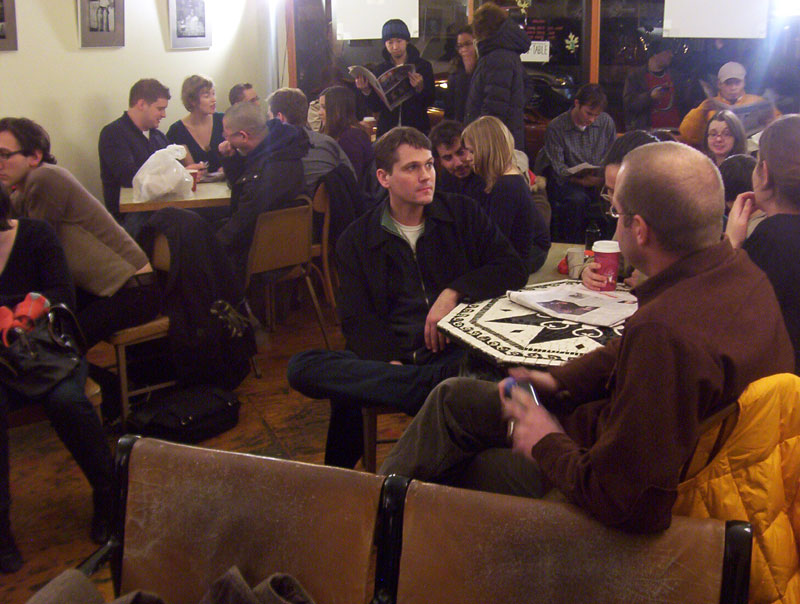
Thursday, December 21, 2006
The Janus Chair
Graham Foust & Sawako Nakayasu
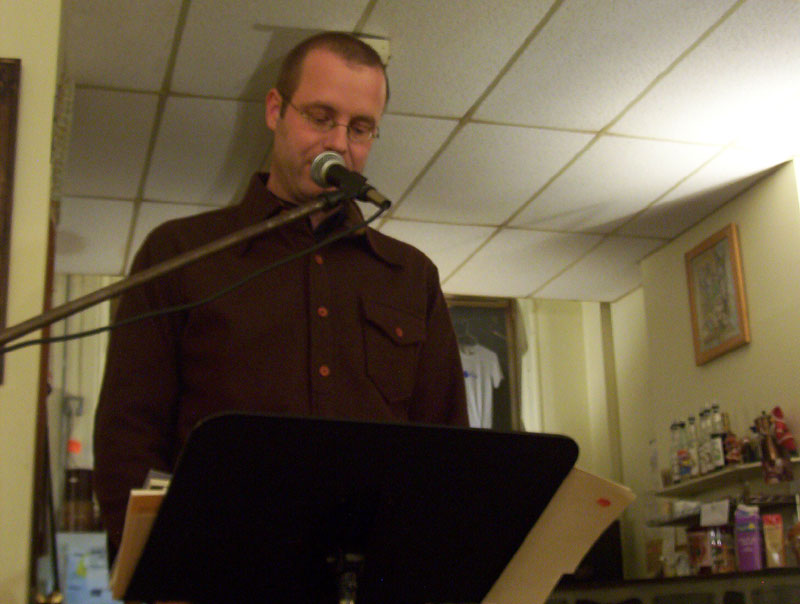
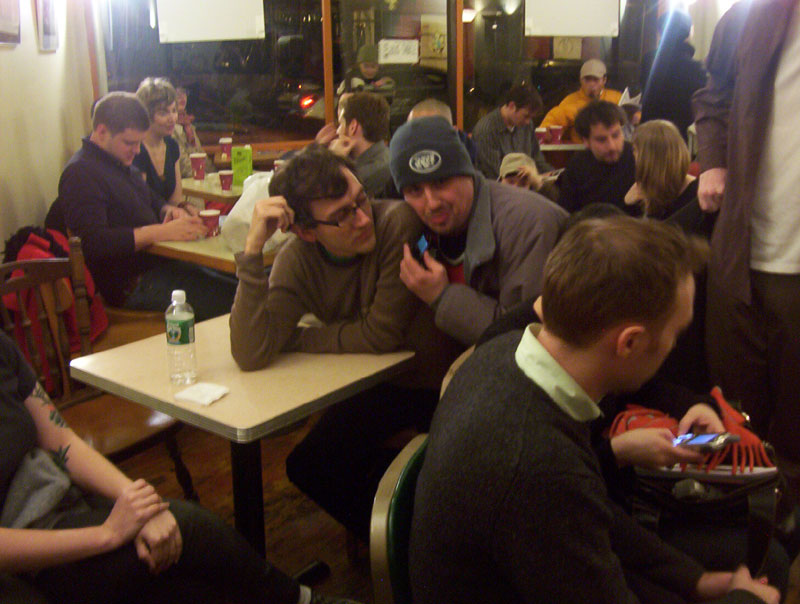
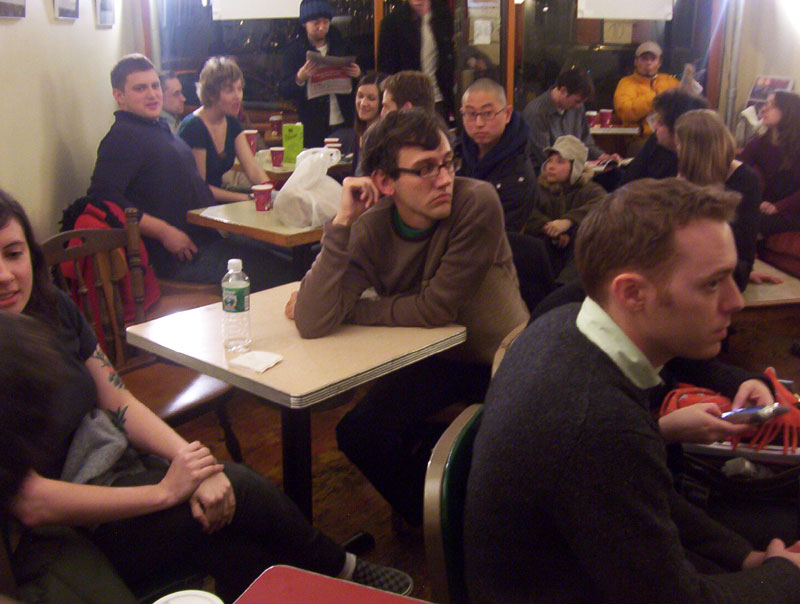
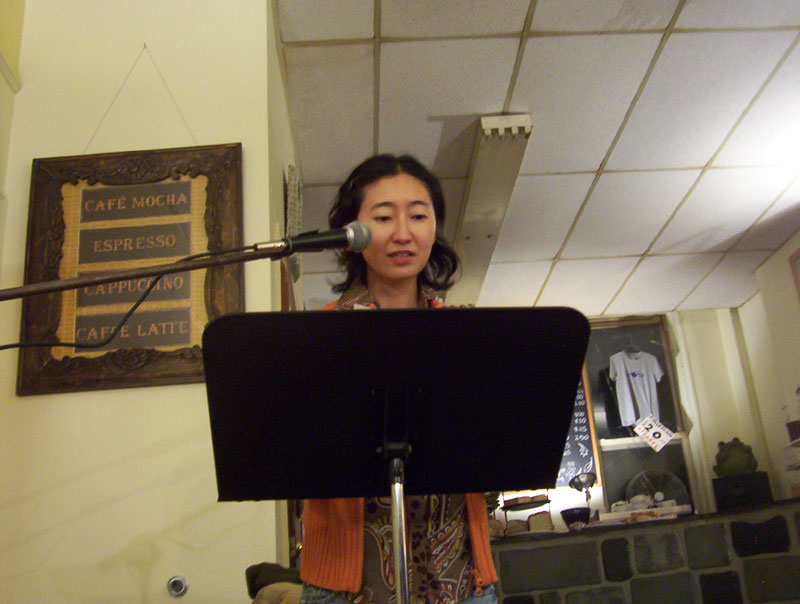
Friday, January 19th, 7 :30 PM
The Fall Café
307 Smith Street
between Union & President
Carroll Garden, Brooklyn
F or G to Carroll Street
FREE
Graham Foust was born in Knoxville, Tennessee and raised in Eau Claire, Wisconsin. The author of three books of poetry--the most recent of which is Necessary Stranger (Flood Editions, 2007)—he lives in Oakland, California with his wife and son.
Sawako Nakayasu is currently writing about, through, on, around and with ants and other insects, but mostly ants. She was born in Yokohama, Japan, and has lived mostly in the US since the age of six. Her books include Nothing fictional but the accuracy or arrangement (she, (Quale Press), So we have been given time Or, (Verse Press), and Clutch (Tinfish). Her most recent publications include a book of translations of Japanese women poets in Four From Japan, as well as a chapbook of translations of Sagawa Chika's poems, from Seeing Eye Books.
Friday, January 19th, 7 :30 PM
The Fall Café
307 Smith Street
between Union & President
Carroll Garden, Brooklyn
F or G to Carroll Street
FREE
Graham Foust was born in Knoxville, Tennessee and raised in Eau Claire, Wisconsin. The author of three books of poetry--the most recent of which is Necessary Stranger (Flood Editions, 2007)—he lives in Oakland, California with his wife and son.
Sawako Nakayasu is currently writing about, through, on, around and with ants and other insects, but mostly ants. She was born in Yokohama, Japan, and has lived mostly in the US since the age of six. Her books include Nothing fictional but the accuracy or arrangement (she, (Quale Press), So we have been given time Or, (Verse Press), and Clutch (Tinfish). Her most recent publications include a book of translations of Japanese women poets in Four From Japan, as well as a chapbook of translations of Sagawa Chika's poems, from Seeing Eye Books.
Sunday, December 10, 2006
All-Time Chair Burners
Kazim Ali, Samuel Amadon, Stephanie Anderson, Reneé Ashley, Andrea Baker, Jim Behrle, Edmund Berrigan, Anne Boyer, Lee Ann Brown, Jenna Cardinale, Adam Clay, Julia Cohen, John Coletti, Carla Conforto, Phil Cordelli, Joshua Corey, Bruce Covey, Simon DeDeo, Michelle Detorie, Timothy Donnelly, kari edwards, Jeff Encke, Joanna Fuhrman, Lara Glenum, Johannes Göransson, Arielle Greenberg, Kate Greenstreet, Jane Gregory, Matt Hart, Matthea Harvey, Anthony Hawley, Brian Howe, Dan Hoy, Thomas Hummel, Brenda Iijima, Kent Johnson, Erica Kaufman, Amy King, Aaron Kunin, Mark Lamoureux, Katy Lederer, Tao Lin, Brendan Lorber, Alex Lemon, Timothy Liu, Sarah Manguso, Sabrina Orah Mark, Justin Marks, Peter Markus, Joseph Massey, Aaron McCollough, Paul McCormick, Andrew Mister, Ange Mlinko, Marie Mockett, Jeff Morgan, Rachel Moritz, Valzhyna Mort, Anna Moschovakis, Gina Myers, Amanda Nadelberg, Eugene Ostashevsky, Juliet Patterson, Christian Peet, Arlo Quint, Thibault Raoult, Chris Salerno, David Shapiro, Brenda Shaughnessy, Frank Sherlock, Brandon Shimoda, Peter Shippy, Sandra Simonds, Sheila Squillante, Heidi Lynn Staples, Stacy Szymaszek, Craig Teicher, Maureen Thorson, Gabriella Torres, Jen Tynes, Charles Valle, G.C. Waldrep, Shanxing Wang, Africa Wayne, Joshua Marie Wilkinson, Dustin Williamson, Jonah Winter, Max Winter, Sam White, Jake Adam York, & Rachel Zucker
Sunday, November 05, 2006
Geraldine Kim. Povel. New York: Fence Books, 2005.
It is difficult to say exactly where the poetry starts in Geraldine Kim’s Povel. A lot happens before you reach what would, in another book of poetry, be considered the text. The book begins with an introduction by Lyn Hejinian, claiming that “there has never been a successful merging of confessional verse poetry and the novel . . . until now.” Before you can consider why on Earth Hejinian would care about this potential merging of styles the intro proceeds to quote a bewildering three-page long book title, which is a comically self-effacing stream of consciousness. And it turns out that Hejinian does not care: the intro is a fake. Another fake-into follows, which is Jim Carrey’s Academy Award acceptance speech given the new title of “Transcript of Geraldine Kim’s Acknowledgment Speech.” Then the previously quoted expansive title reappears in bold font, spread over four pages. After this comes the epigraph: “’Beginning texts by quoting someone else’ –Me.” And then a seemingly nonsensical list that equates important characters in the book to musical instruments. And then we get to the poetry. Or novel in verse. Or whatever.
These false starts and bad jokes refuse a stable, chin-strokingly serious reading of Povel. It takes joy in the silliness in contemporary poetic conventions. However these jokes reinforce the importance of the mocked conventions. Lyn Hejinian is fake-quoted because she is, in fact, a driving influence behind the book. Povel bears significant influence from Hejinian’s My Life in its fragmented creation of personal experience. The acceptance speech points out the strange equivalence between status in award honors and the choosing of first books through poetry contests. Kim gets the chance to both express an exuberance for having her book chosen and to completely undercut the possibility that she would take it this seriously. And it's pretty funny. The epigraph both negates itself and works as a useful epigraph to the satirically self-reflexive narcissism in Povel. There is a formal constraint to the presentation of the work; each stanza has a different kind of justification, left, right, centered and repeated. This constraint, however, is so arbitrary as to be almost a joke on the conventions of formal constraint. Following the body of the book is an almost book-length set of footnotes. The book works to situate the reader between attitudes about poetry and the text before you get to the main body. It tells you that this is a book that both cares reverentially about the conventions of contemporary poetry and also finds them silly. It is as much a book of poetry as it is a work of situating the writer in relation to the forced constraints of a constructed text.
The main text of Povel spills out in a caffeine-fueled dance of statements, individual moments, non-sequiturs, information heard from others or read, family events & pop culture references. The book is so packed that it seems to emulate the Romantic mode in which the expression of experience cannot be written quickly enough (I’m thinking of stories about Shelley writing frantically with both hands). The language of Povel is in action; first person statements lack the subject, instead jumping into the action of each moment. This energy and propulsion is the prosodic driving force to the book.
From the first moment I opened it I found Povel is wildly delightful. The problem with writing a review of it is that this delight is an effect of the book as a text. Any passage is going to lack the provisional situation that makes the writing come alive which makes most of the passages lose their energy when quoted out of context. The book is delightful because of its brash comprehensiveness and inertia. The first stanza sets up some of what makes reading Povel exciting:
My roommate complains to me about how she couldn’t enjoy
Matrix Revolutions because everyone else in the theater was laughing at it. ‘Too
much psychobabble for your puny minds?!’ she asks our dorm room. I glance at her
cow-print slippers. The vomit from my Vicodin overdose was green. One of the first
things I am told as a writer is to write about what I know. (1)
Kim shifts sharply between internal and external, between immediacy and reflection, between concrete and abstract. These shifts are propulsive, and within the framework that the opening materials set up the shifts all seem to be based on a kind of desperate playfulness. These shifts consistently turn attention back to the creation of a sense of self in the book and in the writing of the book. Because of the propulsion this inward turn works to consistently recreate, and further understand Geraldine Kim as a stable entity. She reveals a life in the immediate moment-to-moment expressiveness of experience, but contains enough direct personal connection to allow for it to be read as more than an experiment. Povel is a constantly unfurling, seemingly stream-of-consciousness exploration of an individual attempting to make sense of her coming of age intellectually, culturally and sexually. But this stream is deceptive. Despite the constant search for a new turn or a new move a story builds. Characters reappear. An autobiography develops through the work. Kim doesn’t shy away from including seemingly anything in Povel.
Because of her continuous multiplicity she succeeds in moments that would seem precious in another book. “My dreams where my ex and I are siblings anyway. Feeling as lonely as a dependent/ clause without. Instead I said ‘no’ and watched his sneakers run back in the rain.” (79) But she is also able to include moments of simple presentation that ring especially true in counterpoint to the poetic play. When she talks about her brother Kim is especially direct, turning even the most ridiculous scene into a moment of dry existential wonder such as this moment of understanding budding sexuality:
‘And when I see a guy and girl kissing, it starts to rise,’ my brother says to his
twelve-year-old friends while we’re all watching TV, his voice wavering. ‘Me too!’
says his friend. Feeling extraterrestrial. (76)
Because of the exuberance of revelation Povel continually surprises me. Statements or moments arrive that feel entirely new, but continue to be absorbed by the growing body of Povel. These moments are sometimes immediate and the familiar becomes somehow profound, such as “‘Paypal scamming worm asks for bank/ details’ the computer says. That explains everything.” (13) Some of them are more traditionally imagistic, such as “Imagining the/ inside of my body as a densely crowded forest.” (27).
Even those moments that are so affecting to me are couched in the overall framework of the text and I have to distrust them. What is important about them in the context of Povel is that they are not to be dwelt upon. There may be moments of beauty or personal revelation, but they are always going to be followed by something else. Sometimes the following statement undercuts the effect; more often it is simply disinterested in it. Povel pushes forward, refuses to make any single statement more important than the next.
This form of autobiographical writing, of confessionalism, challenges the reader to mediate between the very things the writer mediates between, ironic awareness of the sterility of conventions (even experimentally-based conventions), a belief in the power of these very conventions, a desire to accurately present a life and the awareness of not only the conceit of this desire but the impossibility of successfully satisfying it. Kim builds this mediation by her switches from meta-contemplation of the text itself, mild profundities, personal experiences and reportage without hesitation:
Thumbing through everything I’ve written. The granite was shaped into a
gravestone. An elaborate attempt at immortality. My avoidance of reading The
Denial of Death on my desk. For his birthday, I got my ex a Jesus nightlight and
seventy-five dollars worth of stickers. The protagonist of Fight Club chose the
penguin as his power animal. ‘Quality over quantity’ my physics teacher said to us.
marx said it was quantity over quality since the chances of quality are higher when
there is more. (54)
This comprehensiveness creates an intimacy that for me is more interesting and direct than the attempt to tell the “story” of a life. It is not a confessional poetry impressed by its own epiphanies nor a revelatory bragging about personal failings but rather an accumulation of experience. It is a fresh form of personal poetics, based on the daily revelations of blogging or late night conversations rather than the linearity of narrative or even the conceptual openness of Hejenian’s My Life.
Neither does Kim attempt a solid stand about sexuality or gender identity, though these are also important to the book. She is constantly aware of the eyes of men on her. They arrive at the most simple times, giving daily life a creepy feel: “I could use my declining dollars all day, drinking coffee and staying permanently/ awake. The guy sitting across from me watches me.” (12) She grows angry in the text at being constantly looked at, but does not display her anger in the actions of the book:
This creates a fascinating and frustrating version of biography. That force me to be aware of the conventions I expect out of autobiography. I came to this book with an expectation that somehow cultural identity would be important to Povel. Perhaps it seemed to me that a young Korean American woman talking about her life would have to focus on categories of cultural identity. Though we know in this book that Kim is Korean American and this comes up frequently she is never attempting anything like a categorical definition of her place in relation to this identity. Out of context I can analyze the cultural politics at work in Povel, such as when she relates “Watching my sixty-six-year-old/ Korean dad copy the gestures of a car dealer on TV. How my tall friend kept on being/ asked if he played basketball.” (111) With any other book I might try to understand the anti-essentialist elements of this, but with Povel I instead move forward into another experience and moment.
‘What were you listening too? It sounded familiar’
the guy sitting next to m says. Stop looking at my legs. ‘I’m sorry was it too loud?’ I
say. Stalling. Go away. ‘No not at all, I was just wondering since it sounded familiar,’
he says. ‘It was Control Machete, a Mexican rap group,’ I say. Dull nodding. ‘And
before I was listening to Cex. C-E-X,’ I say. (33)
She considers the kind of sexual identification by which one builds structures of understanding the world:
Sleeping at my bass teacher’s
apartment when he introduced me to pot and his dick. ‘Kiss it,’ he said in total
seriousness. Since I felt obliged to. Deciding what constitutes ‘rape.’ Before that he
said, ‘You’re beautiful,’ to my black bra. (79)
She expresses her own fourth-wave style redefinition of sexuality and identity as well, at one point stating “It’s pathetic that these knee-high boots give me such joy.” But the following sentence immediately undercuts the potential for digging into these kinds of statements: “I start to get jealous of/Quentin Tarantino. Shit he’s even included on the spell checker.”(39) Though identity is crucial to Povel, it refuses to give you time to stop and attempt a structured system of ideas. Instead Povel resists definition by pushing forward, the moments that could be definitional pass by as quickly as name-checking a punk band or discussing coffee again.
A reader might look for clues or keys within the text for ways to decode and understand Povel. Instead of satisfying this desire Kim packs the book with self reflexive ars poetica statements; rather than giving a single key to the rhetoric of the book the reader receives multiple keys that provide new ways of viewing the writing. In the same way that the book presents identity in action, constantly reforming it presents potential reading strategies that evolve, rather than allowing for a single way to understand it. In the end content gives way to the prosody of propulsion.
And this is the pleasure of Povel, the constant dance and play of self-in-action rather than a static self recollected and recreated for a reader to consume. However there comes a point in this book where the poetic moves Kim pulls fail to surprise. The book becomes too comfortable in its twists and turns. It becomes a novel without a plot, which reflects somehow on the experience of the twenty-year old writer, but does not create a satisfying complete book. By the end of the book a stanza that might have been evocatively puzzlingly is instead too easily understood:
It’s acceptable here. Fold my legs into themselves then sit atop them. Pushing back
chairs that sound like farts. I tried parables. When I was done with the popsicle, I
would chew the fibers of the stick apart. Why I wasn’t born with a filter between my
mouth and brain. A matter of tautology, really. (94)
The movement between internal and external seems rote by this point and the comfort level makes the scatological jokes fall flat rather than providing new ways of looking at a life. With a book that bases so much of its effectiveness on brash intimacy I don’t want to feel safely intimate with it. I feel that this happens because Povel is a book that resists a reader sitting down and reading it in one sitting. It invites you to dip in and out, to find a few great lines and then page forward to find some more.
I say this because the book is thrilling for its brashness, it’s constant play and its willingness to show its smarts & be silly and banal at the same time. Povel is a creation in process. Not only in a standard reading response way but in the mechanisms of how the text relates to itself. Its ideas continue to reach for satisfaction as it reaches for an understanding of identity. Povel resists or works through poetic constraints of both form and expectation to express an individual experience in a manner unmediated by structural clichés. It attempts a convincing confessional mode within a poetic aesthetic based on the prosodic experimentation (and implicit anti-Confessionalism) of the Language poets. It is not the reporting of a life but an attempt to present the experiential qualities of a life. There is not beginning or ending. You can open it anywhere and find some moment of delight, some moment that evocatively situates the highly poetic with the mundane or even the crass.
--Review by Mathias Svalina.Wednesday, October 25, 2006
Sunday at The Fall Cafe
The Burning Chair Readings
Encourage You To
Get Down With Your Bad Self
w/ the hardest working poets in show business
Kazim Ali, Bruce Covey & Juliet Patterson
Sunday, October 29th, 6PM
@ The Fall Café
307 Smith Street
Between Union & President
Carroll Gardens, Brooklyn
F or G to Carroll Street
FREE
Kazim Ali's first book of poetry won Alice James Books' New England/New York Prize and was published in 2005. He's also the author of a novel, Quinn's Passage. Kazim is the publisher of Nightboat Books, assistant professor of English at Shippensburg University and teaches at Stonescoast, the low-residency MFA program of the University of Southern Maine.
Bruce Covey is Lecturer of Creative Writing at Emory University and the author of The Greek Gods as Telephone Wires and the forthcoming Ten Pins, Ten Frames (Front Room Publishers, Ann Arbor) and Elapsing Speedway Organism (No Tell Books, Washington, DC), both due to be published in the fall of 2006. His recent poems also appear or are forthcoming in 26, Cannibal, Bird Dog, Aufgabe, Verse, LIT, Bombay Gin, Boog City, Explosive Magazine, 580 Split, and other journals. He edits the web-based poetry magazine Coconut (www.coconutpoetry.org) and curates the What’s New in Poetry reading series in Atlanta.
Juliet Patterson’s first book, The Truant Lover, was selected by Jean Valentine as the 2004 winner of the Nightboat Poetry Prize. Her poems have appeared or are forthcoming in American Letters & Commentary, Bellingham Review, Bloom, Conduit, Hayden’s Ferry Review, New Orleans Review, The Journal,Verse and other magazines. She is the recipient of a SASE/Jerome fellowship in poetry, a 2004 fellowship with the Institute for Community and Cultural Development through Intermedia Arts in Minneapolis, and an arts fellowship from the Minnesota State Arts Board. She teaches poetry and creative writing in Minneapolis through the College of St. Catherine, Hamline University, The Loft Literary Center, and the Perpich Center for Arts Education. She has worked with children as a volunteer educator with the Minnesota Advocates for Human Rights and with the United Cambodian Association of Minnesota youth programs. She lives near the west bank of the Mississippi in Minneapolis. For more information, visit her website:
Tuesday, October 17, 2006
Two Readings This Weekend
Live Like You Want to Live, Baby,
w/ The Burning Chair Readings
Lee Ann Brown, Joanna Fuhrman, & Erica Kaufman
Friday, October 20th, 7PM
The Fall Café, 307 Smith Street, between Union & President
F or G to Carroll Street
Adam Clay & Kate Greentreet
In celebration of their books The Wash & case sensitive
Saturday, October 21st, 8PM
Pierogi Gallery, North 9th Street, between Bedford & Driggs
L to Bedford or B61 Bus
BYOB
Contact matthenriksen AT yahoo DOT com or 917-478-5682
Bios
Born in Japan on October 11th, 1963, Lee Ann Brown is a poet, filmmaker, performer who now divides her time between New York City and Marshall, North Carolina in the Blue Ridge mountains. She is Assistant Professor of English at St. John’s University, and occasionally teaches as part of Naropa University's Writing and Poetics Program. She is also founder and editor of Tender Buttons Press. Her books include The Sleep That Changed Everything (Wesleyan), Polyverse (Sun & Moon Press), and she just got back from the southern portions of the 2006 Wave Book Tour.
Joanna Fuhrman is the author of three books of poetry published by Hanging Loose Press, Freud in Brooklyn (2000), Ugh Ugh Ocean (2003) and Moraine (2006). Her poems have appeared in all the usual places: New American Writing. Conduit, Lit, Court Green, American Letters and Commentary, and in anthologies published by Carnegie Mellon Press, HarperCollins and Soft Skull Press. She works as a private tutor, and teaches creative writing in the NYC public schools.
Erica Kaufman co-curates the belladonna* reading series/small press and is the author of the chapbooks: from the two coat syndrome , the kickboxer suite, and a familiar album (winner of the 2003 New School Chapbook Contest). Her poems have appeared in or are forthcoming in Puppy Flowers, Bombay Gin, The Mississippi Review, jubilat, Good Foot, CARVE, and elsewhere. Other things are also coming soon from different places.
Adam Clay lives in Kalamazoo, Michigan. Parlour Press recently released his first book, The Wash. Recent poems appear in Denver Quarterly, CutBank, and Barrow Street.
Kate Greenstreet's chapbook, Learning the Language, was published by Etherdome Press in 2005. Her first full-length book, case sensitive, is newly available from Ahsahta Press. Her blog, Every Other Day, lives at www.kategreenstreet.com.
Thursday, September 28, 2006
The Burning Chair Readings
Say Why the Hell Not
Whirligig it Like Ya Mean it w/
Dan Hoy, Justin Marks & Chris Salerno
Friday, September 29th, 7:29 PM
@ The Fall Café
307 Smith Street
Between Union & President
Carroll Gardens, Brooklyn
F or G to Carroll
Free, dude.
No outside booze, please.
Dan Hoy lives in Brooklyn and is co-editor of SOFTTARGETS. His work has appeared or is forthcoming injubilat, Octopus, H_NGM_N, Effing, the tiny, CUE: AJournal of Prose Poetry, and elsewhere. His moviecriticism and videos are available on his website,www.sinlechuga.com.
Justin Marks' poems have appeared in The LiteraryReview, MiPoesis, McSweeney's, Typo, Word for/ Word,Can We Have Our Ball Back?, and are forthcoming inH_NGM_N, Fulcrum and the Outside Voices 2008 Anthologyof Younger Poets. His chapbook, You Being You byProxy, is available on Kitchen Press. He is editor ofLIT and lives in NYC.
Christopher Salerno's first book, Whirligig, wasshortlisted for the Walt Whitman Award and wasrecently published by Spuyten Duyvil Publishing House.His poems can be found in such journals as: Verse,LIT, Carolina Quarterly, Colorado Review, Jacket,Jubilat, The Tiny, MiPOesias, New Hampshire Review,Free Verse, Forklift Ohio, Electronic Poetry Review,Barrow Street, River City, and others. Two of hisrecent poems are included in the anthology, The Bedside Guide to No Tell Motel and others will appearin the forthcoming Outside Voices anthology. Hecurrently teaches Poetry Writing, American Literature,and First-Year Writing at North Carolina StateUniversity in Raleigh, NC. He blogs atwww.christophersalerno.blogspot.com.
Forthcoming:
At The Fall Cafe:
October 20th Lee Ann Brown, Joanna Fuhrman, & EricaKaufman
October 29th Kazim Ali, Bruce Covey, & JulietPatterson
November 17th Julia Cohen, Mark Lamoureux, & AfricaWayne
At the Pierogi Gallery:
October 21st Adam Clay & Kate Greenstreet
Say Why the Hell Not
Whirligig it Like Ya Mean it w/
Dan Hoy, Justin Marks & Chris Salerno
Friday, September 29th, 7:29 PM
@ The Fall Café
307 Smith Street
Between Union & President
Carroll Gardens, Brooklyn
F or G to Carroll
Free, dude.
No outside booze, please.
Dan Hoy lives in Brooklyn and is co-editor of SOFTTARGETS. His work has appeared or is forthcoming injubilat, Octopus, H_NGM_N, Effing, the tiny, CUE: AJournal of Prose Poetry, and elsewhere. His moviecriticism and videos are available on his website,www.sinlechuga.com.
Justin Marks' poems have appeared in The LiteraryReview, MiPoesis, McSweeney's, Typo, Word for/ Word,Can We Have Our Ball Back?, and are forthcoming inH_NGM_N, Fulcrum and the Outside Voices 2008 Anthologyof Younger Poets. His chapbook, You Being You byProxy, is available on Kitchen Press. He is editor ofLIT and lives in NYC.
Christopher Salerno's first book, Whirligig, wasshortlisted for the Walt Whitman Award and wasrecently published by Spuyten Duyvil Publishing House.His poems can be found in such journals as: Verse,LIT, Carolina Quarterly, Colorado Review, Jacket,Jubilat, The Tiny, MiPOesias, New Hampshire Review,Free Verse, Forklift Ohio, Electronic Poetry Review,Barrow Street, River City, and others. Two of hisrecent poems are included in the anthology, The Bedside Guide to No Tell Motel and others will appearin the forthcoming Outside Voices anthology. Hecurrently teaches Poetry Writing, American Literature,and First-Year Writing at North Carolina StateUniversity in Raleigh, NC. He blogs atwww.christophersalerno.blogspot.com.
Forthcoming:
At The Fall Cafe:
October 20th Lee Ann Brown, Joanna Fuhrman, & EricaKaufman
October 29th Kazim Ali, Bruce Covey, & JulietPatterson
November 17th Julia Cohen, Mark Lamoureux, & AfricaWayne
At the Pierogi Gallery:
October 21st Adam Clay & Kate Greenstreet
Monday, September 18, 2006
Michael Sikkema. CODE OVER CODE. Lame House Press: 2006.
“One Truly Human Act” —Sikkema & Simple Wants
Despite a surface flash, a linguistic rupture that permeates some of the poems (or poetic utterances) that make up CODE OVER CODE, Sikkema's work is a profoundly human one, a searching utterance.
The book begins simply enough, with the controlling consciousness, the center of the vortex, proclaiming, “I wanted everything with you to be nicely round in a square of berry patch,/dirt and sky.” So much of what this book, finally, generates for the reader is initiated here, a revving that spans the length of the collection. Here is urge towards coupled with wariness of; there is a cynicism here that wants the “round” to exist in the “square,” that wants the impossibility of non-conformity within conformity & is still naïve enough to think that, if it can be achieved, there will be a nicety to it all. The book, then, the rest of the poems, are notes from the war, the speaker’s realization that this cannot be—implied syntactically already: I wanted…
If the world view of CODE OVER CODE is “romantic,” if it can be said to aspire to “organic unity,” the project of CODE OVER CODE, what the poems accomplish, can be said to reveal to us an interrogation of that Romantic sensibility & the fact that we live in a world that is openly antagonistic to it. Such simple & lovely & intimate whispers such as “Here is where I am looking at you/in me” have no place in the new mechanisms of poetic language, which use the gears of irony & fear & distrust to spin our selves further & further from real human connections.
Sikkema’s speaker asks “Is there one truly human act left?” The direct answer seems to be no, or at least that it is decidedly not the kind of act we want to be remembered for. Pure animal functioning does not make a human & I stand with Sikkema, chagrined & angry, baffled that we live in an age where poetry that enacts the purer functions of emotion (including, yes, love) is viewed suspiciously.
--Review by . Nate Pritts
Despite a surface flash, a linguistic rupture that permeates some of the poems (or poetic utterances) that make up CODE OVER CODE, Sikkema's work is a profoundly human one, a searching utterance.
The book begins simply enough, with the controlling consciousness, the center of the vortex, proclaiming, “I wanted everything with you to be nicely round in a square of berry patch,/dirt and sky.” So much of what this book, finally, generates for the reader is initiated here, a revving that spans the length of the collection. Here is urge towards coupled with wariness of; there is a cynicism here that wants the “round” to exist in the “square,” that wants the impossibility of non-conformity within conformity & is still naïve enough to think that, if it can be achieved, there will be a nicety to it all. The book, then, the rest of the poems, are notes from the war, the speaker’s realization that this cannot be—implied syntactically already: I wanted…
If the world view of CODE OVER CODE is “romantic,” if it can be said to aspire to “organic unity,” the project of CODE OVER CODE, what the poems accomplish, can be said to reveal to us an interrogation of that Romantic sensibility & the fact that we live in a world that is openly antagonistic to it. Such simple & lovely & intimate whispers such as “Here is where I am looking at you/in me” have no place in the new mechanisms of poetic language, which use the gears of irony & fear & distrust to spin our selves further & further from real human connections.
Sikkema’s speaker asks “Is there one truly human act left?” The direct answer seems to be no, or at least that it is decidedly not the kind of act we want to be remembered for. Pure animal functioning does not make a human & I stand with Sikkema, chagrined & angry, baffled that we live in an age where poetry that enacts the purer functions of emotion (including, yes, love) is viewed suspiciously.
--Review by . Nate Pritts
Wednesday, September 13, 2006
The Burning Chair Readings
Invite you, pussycat,
To resign yourself to the luxurious pleasure
Of auricular satisfaction
w/
auricular sensations
from
Thibault Raoult, Sandra Simonds & Maureen Thorson
Friday, September 15th, 7:30 PM
@
The Fall Café
307 Smith Street
Between Union & President
Carroll Gardens, Brooklyn
F/G to Carroll Street
Of course
always
FREE & FUN
www.typomag.com/burningchair
~
Bios:
Thibault Raoult was a Dolin Scholar at the University of Chicago. One of his pieces in Octopus #4 was nominated for a Pushcart Prize. He co-edits Coalesce (with Adam Weg), writes songs, paints, cooks, & cleans (sometimes) in the nude (sometimes). Born in Pithiviers, France, raised in Rochester, NY, Thibault will soon move to Providence, RI.
Sandra Simonds is a Phd student in Creative Writing at Florida State University. Her poems have been published in the Colorado Review, Seneca Review, Barrow Street, e, Castagraf, Cannibal, California Quarterly, Ampersand, 3am and others. She edits Wildlife Poetry Magazine.
Maureen Thorson lives in Washington, D.C., where she is sometimes a lawyer. Her work has appeared in numerous tiny chapbooks, some magazines, and often in her head. She is editor, publisher, and janitor of Big Game Books, the smallest press in the world.
Friday, September 08, 2006
HELP
Hi.
I need to get in touch with these poets:
Erin Martin
Kenneth Harrison
Peter Milne
Craig Blais
Megan Mercado
Ash Smith
Please help. Email: adam (AT) adamclay.org
I need to get in touch with these poets:
Erin Martin
Kenneth Harrison
Peter Milne
Craig Blais
Megan Mercado
Ash Smith
Please help. Email: adam (AT) adamclay.org
Thursday, August 24, 2006
Best of Net Nominess 2006
Aase Berg (trans. Johannes Göransson)
from Uppland
Anne Boyer
“A Romance of Happy Workers”
Sabrina Orah Mark
“Beatrice Takes a Lover”
Karyna McGlynn
”Would You Like Me to Walk Your Baby?”
Amanda Nadelberg
“Pancrazio”
Henry Parland (trans. Johannes Göransson)
from Socks
from Uppland
Anne Boyer
“A Romance of Happy Workers”
Sabrina Orah Mark
“Beatrice Takes a Lover”
Karyna McGlynn
”Would You Like Me to Walk Your Baby?”
Amanda Nadelberg
“Pancrazio”
Henry Parland (trans. Johannes Göransson)
from Socks
Wednesday, August 16, 2006
Fall Line Up
Always Free!
The Fall Café
307 Smith Street
Carroll Gardens, Brooklyn
Fridays, 7:30 PM
August 18th______Jenna Cardinale, Michelle Detorie, & Arlo Quint
September 15th___Thibault Raoult, Sandra Simonds, & Maureen Thorson
September 22nd___Jane Gregory, Frank Sherlock, & Jake Adam York
September 29th___Dan Hoy, Justin Marks, & Chris Salerno
October 20th_____Lee Ann Brown, Joanna Fuhrman, & Erica Kaufman
November 17th ___Julia Cohen, Mark Lamoureaux, & Africa Wayne
The Fall Cafe
Sundays, 6PM
August 27th _____Reneé Ashley & Shanxing Wang
October 29th ____Kazim Ali, Bruce Covey, & Juliet Patterson
Pierogi Gallery
177 North 9th Street
Williamsburg, Brooklyn
Saturdays, 8PM
September 23rd __Alex Lemon & Brenda Shaughnessy
October 21st ____Adam Clay & Kate Greenstreet
The Fall Café
307 Smith Street
Carroll Gardens, Brooklyn
Fridays, 7:30 PM
August 18th______Jenna Cardinale, Michelle Detorie, & Arlo Quint
September 15th___Thibault Raoult, Sandra Simonds, & Maureen Thorson
September 22nd___Jane Gregory, Frank Sherlock, & Jake Adam York
September 29th___Dan Hoy, Justin Marks, & Chris Salerno
October 20th_____Lee Ann Brown, Joanna Fuhrman, & Erica Kaufman
November 17th ___Julia Cohen, Mark Lamoureaux, & Africa Wayne
The Fall Cafe
Sundays, 6PM
August 27th _____Reneé Ashley & Shanxing Wang
October 29th ____Kazim Ali, Bruce Covey, & Juliet Patterson
Pierogi Gallery
177 North 9th Street
Williamsburg, Brooklyn
Saturdays, 8PM
September 23rd __Alex Lemon & Brenda Shaughnessy
October 21st ____Adam Clay & Kate Greenstreet
The Burning Chair cordially invites you to once again
Come On Get Happy!
w/
Jenna Cardinale, Michelle Detorie, & Arlo Quint
@
The Fall Café
307 Smith Street
btwn. Union & Smith
Carroll Gardens, Brooklyn
on
Friday, August 18th
730 PM
It’ll be like we never took a vacation.
Keep an eye out, because the entire fall line up is coming soon.
Jenna Cardinale is the author of Journals (Whole Coconut, 2006). Her poems appear in recent or forthcoming issues of nthposition, Cannibal, Court Green and eratio, among others. She teaches poetry writing at Lehman College and Explorations Academy, an experimental public high school in the Bronx.
Michelle Detorie lives in Kyle, TX where she is the writer-in-residence at the Katherine Anne Porter house. Her poems have appeared in Chelsea, Verse Daily, Typo, DIAGRAM, and elsewhere.
Arlo Quint is author of Days on End from Open 24 Hours press. Some of his poems have recently appeared in The Recluse and others are forthcoming in Cannibal. He lives in Brooklyn.
Come On Get Happy!
w/
Jenna Cardinale, Michelle Detorie, & Arlo Quint
@
The Fall Café
307 Smith Street
btwn. Union & Smith
Carroll Gardens, Brooklyn
on
Friday, August 18th
730 PM
It’ll be like we never took a vacation.
Keep an eye out, because the entire fall line up is coming soon.
Jenna Cardinale is the author of Journals (Whole Coconut, 2006). Her poems appear in recent or forthcoming issues of nthposition, Cannibal, Court Green and eratio, among others. She teaches poetry writing at Lehman College and Explorations Academy, an experimental public high school in the Bronx.
Michelle Detorie lives in Kyle, TX where she is the writer-in-residence at the Katherine Anne Porter house. Her poems have appeared in Chelsea, Verse Daily, Typo, DIAGRAM, and elsewhere.
Arlo Quint is author of Days on End from Open 24 Hours press. Some of his poems have recently appeared in The Recluse and others are forthcoming in Cannibal. He lives in Brooklyn.
Thursday, June 22, 2006
An open letter to Amanda Nadelberg from Andrea Baker
Re: Isa the Truck Named Isadore (Slope Editions, 2006)
Dear Amanda,
If I had your cell phone
Number I would call and tell you
How lovely your book and reading were
But actually I’m shy and would not call but
I like to think that I would and I would like to write
A review and say how good your book is which I purchased last night at
Your reading here in Brooklyn hosted by the Burning Chair Series but I don’t know if it’s
Ethical to write a review when we share a press. And I was interested in your work for a while
But when I heard you read that poem about the Fifle in American Tale and
Jews and many other poems which were very very good and so refreshing because they were
Happy and sort of hip but chipper and underscored by goodness, I brought your book home and read it this morning-
It is making me feel so good. Frank O’hara was one of the first poets I felt attached to
I loved that poem Why I Am Not a Painter when I was in high school
But I can’t really get into him anymore though I would like to but
The Frank O’hara-ness of your poems I can get into though they are Midwestern and not
At all New York
I like them so much. So thank you. Also
People should buy your book because the poems are good and fun
Individually but really super-good and super-fun when read all-together.
Roses From,
Andrea
Dear Amanda,
If I had your cell phone
Number I would call and tell you
How lovely your book and reading were
But actually I’m shy and would not call but
I like to think that I would and I would like to write
A review and say how good your book is which I purchased last night at
Your reading here in Brooklyn hosted by the Burning Chair Series but I don’t know if it’s
Ethical to write a review when we share a press. And I was interested in your work for a while
But when I heard you read that poem about the Fifle in American Tale and
Jews and many other poems which were very very good and so refreshing because they were
Happy and sort of hip but chipper and underscored by goodness, I brought your book home and read it this morning-
It is making me feel so good. Frank O’hara was one of the first poets I felt attached to
I loved that poem Why I Am Not a Painter when I was in high school
But I can’t really get into him anymore though I would like to but
The Frank O’hara-ness of your poems I can get into though they are Midwestern and not
At all New York
I like them so much. So thank you. Also
People should buy your book because the poems are good and fun
Individually but really super-good and super-fun when read all-together.
Roses From,
Andrea
Wednesday, June 21, 2006
Anne Boyer & The Pines Sunday, June 25th
The Burning Chair Readings
want you to
get auricular
w/
Anne Boyer
&
The Pines (Phil Cordelli & Brandon Shimoda)
Sunday, June 25th, 4PM
The Cloister Café
238 East 9th Street
Between 2nd & 3rd Avenues
East Village, NYC
Always, always free.
Our last reading of the season!
Contact Matthew Henriksen
917-478-5682
matt at typomag dot come
Anne Boyer was born in Kansas in 1973. She grew up in Salina, a small city in the very enter of the country, just south of the World's Largest Ball of Twine. A life-long Midwesterner, she earned degrees at Kansas State University and Wichita State University, lived for a time in Kansas City, Missouri, and now lives in central Iowa where she raises her daughter and teaches creative writing at Drake University. Her poetry and prose can be found in a variety of journals, including Typo, Cannibal, The Denver Quarterly, The Canary, and Lit. Her first book is forthcoming from Coffee House Press.
Phil Cordelli and Brandon Shimoda have been collaborating on various projects since the early 1990s. Their collaborative writing has appeared under the name “The Pines” in such journals as POOL, BlazeVOX, Cannibal, and elsewhere, as well as in the ongoing book series, The Pines. Volume One: Southern California and Volume Two: Ridgefield Connecticut, were both released in 2005, with Volume Three: The Knights of Columbus following in March of 2006. Together and apart they have lived and worked in Acadia National Park, Albany, Asheville, Boston, Bronxville, Brooklyn, Capay, Chatsworth, Cottage Grove, Hopkins Village, Jersey City, Mount Vernon, Oaxaca, Overijse, Pacifica, Pleasantville, Point Arena, Ridgefield, Saratoga Springs, Studio City, Troy, Woodfin, and Yonkers, and help to edit CutBank, Ugly Duckling Presse, and Octopus Magazine. They currently live in Manhattan and Missoula, and at thepines.blogspot.com, respectively.
want you to
get auricular
w/
Anne Boyer
&
The Pines (Phil Cordelli & Brandon Shimoda)
Sunday, June 25th, 4PM
The Cloister Café
238 East 9th Street
Between 2nd & 3rd Avenues
East Village, NYC
Always, always free.
Our last reading of the season!
Contact Matthew Henriksen
917-478-5682
matt at typomag dot come
Anne Boyer was born in Kansas in 1973. She grew up in Salina, a small city in the very enter of the country, just south of the World's Largest Ball of Twine. A life-long Midwesterner, she earned degrees at Kansas State University and Wichita State University, lived for a time in Kansas City, Missouri, and now lives in central Iowa where she raises her daughter and teaches creative writing at Drake University. Her poetry and prose can be found in a variety of journals, including Typo, Cannibal, The Denver Quarterly, The Canary, and Lit. Her first book is forthcoming from Coffee House Press.
Phil Cordelli and Brandon Shimoda have been collaborating on various projects since the early 1990s. Their collaborative writing has appeared under the name “The Pines” in such journals as POOL, BlazeVOX, Cannibal, and elsewhere, as well as in the ongoing book series, The Pines. Volume One: Southern California and Volume Two: Ridgefield Connecticut, were both released in 2005, with Volume Three: The Knights of Columbus following in March of 2006. Together and apart they have lived and worked in Acadia National Park, Albany, Asheville, Boston, Bronxville, Brooklyn, Capay, Chatsworth, Cottage Grove, Hopkins Village, Jersey City, Mount Vernon, Oaxaca, Overijse, Pacifica, Pleasantville, Point Arena, Ridgefield, Saratoga Springs, Studio City, Troy, Woodfin, and Yonkers, and help to edit CutBank, Ugly Duckling Presse, and Octopus Magazine. They currently live in Manhattan and Missoula, and at thepines.blogspot.com, respectively.
Saturday, May 27, 2006
Harvey, Kunin & Shippy: Sunday, May 28th
There is no shaming in hearing
Matthea Harvey, Aaron Kunin & Peter Jay Shippy
Sunday, May 28th, 4PM
The Cloister Café
238 East 9th Street
Between 2nd & 3rd Avenues
East Village, NYC
The Burning Chair Blog: www:typomag.com/burningchair
Contact: Matthew Henriksen at matt at typomag dot com
Author Bios
Matthea Harvey’s books include Sad Little Breathing Machine (Greywolf Press) and Pity the Bathtub Its Forced Embrace of the Human Form (Alice James Books). She serves as poetry editor of American Letters and Commentary.
Aaron Kunin is the author of Folding Ruler Star (Fence Books), a collection of small poems about shame; a novel, The Mandarin, is forthcoming in 2007. His work has appeared in The Germ, No: A Journal of the Arts, The Poker, and elsewhere. He recently moved to California, where he is an assistant professor of negative anthropology at Pomona College.
Peter Jay Shippy's first book, Thieves' Latin (University of Iowa Press) won the 2002 Iowa Poetry Prize. BlazeVOX Books will publish Alphaville, an abecedarian suite, as an e-book in 2006. About Thieves' Latin, Bin Ramke, editor of the Denver Quarterly wrote, "Shippy's strange little machines of words are all kinetic, disturbing, and weirdly graceful, unlike anything else available in American poetry. A dazzling book." Claudia Keelan called it, "... a surrealist elegy for the earth... a fierce accomplishment." His work has been published in numerous journals, including The American Poetry Review, Fence, FIELD, The Iowa Review, McSweeney's Internet Tendency and Ploughshares, among others. Shippy has been awarded writing fellowships from the Massachusetts Cultural Council and the National Endowment for the Arts. In 2005 he received a Gertrude Stein Award for innovative poetry. He teaches at Emerson College and lives with his wife in Jamaica Plain, Massachusetts.
Matthea Harvey, Aaron Kunin & Peter Jay Shippy
Sunday, May 28th, 4PM
The Cloister Café
238 East 9th Street
Between 2nd & 3rd Avenues
East Village, NYC
The Burning Chair Blog: www:typomag.com/burningchair
Contact: Matthew Henriksen at matt at typomag dot com
Author Bios
Matthea Harvey’s books include Sad Little Breathing Machine (Greywolf Press) and Pity the Bathtub Its Forced Embrace of the Human Form (Alice James Books). She serves as poetry editor of American Letters and Commentary.
Aaron Kunin is the author of Folding Ruler Star (Fence Books), a collection of small poems about shame; a novel, The Mandarin, is forthcoming in 2007. His work has appeared in The Germ, No: A Journal of the Arts, The Poker, and elsewhere. He recently moved to California, where he is an assistant professor of negative anthropology at Pomona College.
Peter Jay Shippy's first book, Thieves' Latin (University of Iowa Press) won the 2002 Iowa Poetry Prize. BlazeVOX Books will publish Alphaville, an abecedarian suite, as an e-book in 2006. About Thieves' Latin, Bin Ramke, editor of the Denver Quarterly wrote, "Shippy's strange little machines of words are all kinetic, disturbing, and weirdly graceful, unlike anything else available in American poetry. A dazzling book." Claudia Keelan called it, "... a surrealist elegy for the earth... a fierce accomplishment." His work has been published in numerous journals, including The American Poetry Review, Fence, FIELD, The Iowa Review, McSweeney's Internet Tendency and Ploughshares, among others. Shippy has been awarded writing fellowships from the Massachusetts Cultural Council and the National Endowment for the Arts. In 2005 he received a Gertrude Stein Award for innovative poetry. He teaches at Emerson College and lives with his wife in Jamaica Plain, Massachusetts.
Harvey, Kunin & Shippy in NYC Sunday, May 28th
There is no shaming in hearing
Matthea Harvey, Aaron Kunin & Peter Jay Shippy
Sunday, May 28th, 4PM
The Cloister Café
238 East 9th Street
Between 2nd & 3rd Avenues
East Village, NYC
The Burning Chair Blog: www:typomag.com/burningchair
Contact: Matthew Henriksen at matt@typomag.com
Author Bios
Matthea Harvey's books include Sad Little Breathing Machine (Greywolf Press)
and Pity the Bathtub Its Forced Embrace of the Human Form (Alice James Books).
She serves as poetry editor of American Letters and Commentary.
Aaron Kunin is the author of Folding Ruler Star (Fence Books), a collection of
small poems about shame; a novel, The Mandarin, is forthcoming in 2007. His
work has appeared in The Germ, No: A Journal of the Arts, The Poker, and
elsewhere. He recently moved to California, where he is an assistant professor
of negative anthropology at Pomona College.
Peter Jay Shippy's first book, Thieves' Latin (University of Iowa Press) won the
2002 Iowa Poetry Prize. BlazeVOX Books will publish Alphaville, an abecedarian
suite, as an e-book in 2006. About Thieves' Latin, Bin Ramke, editor of the
Denver Quarterly wrote, "Shippy's strange little machines of words are all
kinetic, disturbing, and weirdly graceful, unlike anything else available in
American poetry. A dazzling book." Claudia Keelan called it, "... a surrealist
elegy for the earth... a fierce accomplishment." His work has been published
in numerous journals, including The American Poetry Review, Fence, FIELD, The
Iowa Review, McSweeney's Internet Tendency and Ploughshares, among others.
Shippy has been awarded writing fellowships from the Massachusetts Cultural
Council and the National Endowment for the Arts. In 2005 he received a Gertrude
Stein Award for innovative poetry. He teaches at Emerson College and lives with
his wife in Jamaica Plain, Massachusetts.
Matthea Harvey, Aaron Kunin & Peter Jay Shippy
Sunday, May 28th, 4PM
The Cloister Café
238 East 9th Street
Between 2nd & 3rd Avenues
East Village, NYC
The Burning Chair Blog: www:typomag.com/burningchair
Contact: Matthew Henriksen at matt@typomag.com
Author Bios
Matthea Harvey's books include Sad Little Breathing Machine (Greywolf Press)
and Pity the Bathtub Its Forced Embrace of the Human Form (Alice James Books).
She serves as poetry editor of American Letters and Commentary.
Aaron Kunin is the author of Folding Ruler Star (Fence Books), a collection of
small poems about shame; a novel, The Mandarin, is forthcoming in 2007. His
work has appeared in The Germ, No: A Journal of the Arts, The Poker, and
elsewhere. He recently moved to California, where he is an assistant professor
of negative anthropology at Pomona College.
Peter Jay Shippy's first book, Thieves' Latin (University of Iowa Press) won the
2002 Iowa Poetry Prize. BlazeVOX Books will publish Alphaville, an abecedarian
suite, as an e-book in 2006. About Thieves' Latin, Bin Ramke, editor of the
Denver Quarterly wrote, "Shippy's strange little machines of words are all
kinetic, disturbing, and weirdly graceful, unlike anything else available in
American poetry. A dazzling book." Claudia Keelan called it, "... a surrealist
elegy for the earth... a fierce accomplishment." His work has been published
in numerous journals, including The American Poetry Review, Fence, FIELD, The
Iowa Review, McSweeney's Internet Tendency and Ploughshares, among others.
Shippy has been awarded writing fellowships from the Massachusetts Cultural
Council and the National Endowment for the Arts. In 2005 he received a Gertrude
Stein Award for innovative poetry. He teaches at Emerson College and lives with
his wife in Jamaica Plain, Massachusetts.
Subscribe to:
Posts (Atom)